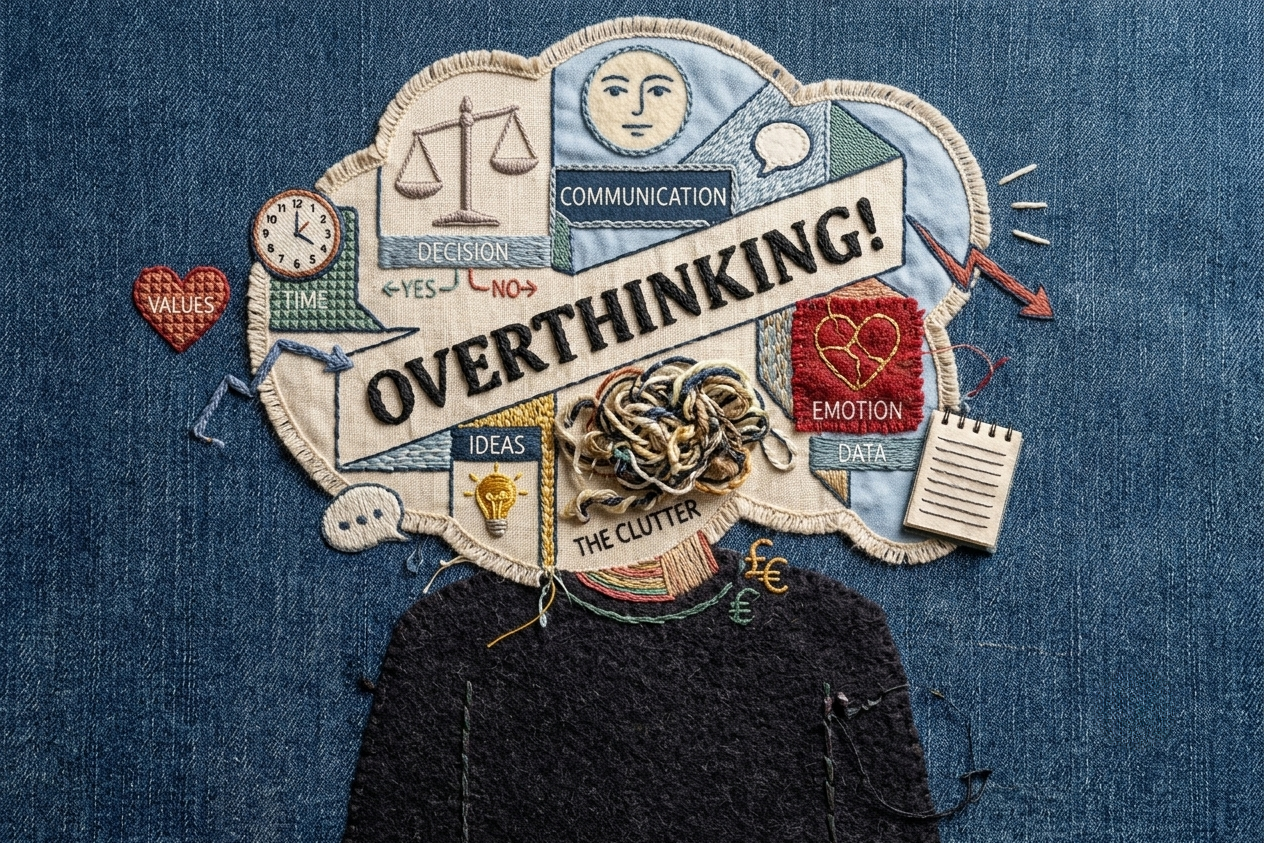
If I am being completely honest with myself on this journey of learning how to love and treat myself well, there is one confession I have to make: I really do not like my brain. I hate the way it works, and most of all, I hate the intensity of my overthinking.
For the longest time, for more than decades, stretching all the way back to when I was a very little girl, I didn’t even realize I was doing it. To me, a hyper-vigilant mind was just the default setting of existence. It is only recently, with the benefit of adult perspective, that I have begun to understand the exact soil in which this mental exhaustion grew.
In psychology and modern self-help literature, there is a phrase that has become quite well-known: “walking on eggshells.” As a child, I lacked the vocabulary to understand that this was the exact emotional ecosystem of my home. I couldn’t see that my mother was trapped in a perpetual state of walking on eggshells herself, her mind constantly racing with a desperate need to anticipate and control the opinions of the outside world.
Tragically, she raised me using the very survival mechanisms she had developed. Her maternal guidance was almost entirely built upon a single, rigid foundation: “You have to do this, because that person might think about you like this.” This anxious projection dictated everything she did, and it applied to everything she saw within me. If I didn’t immediately bend my behavior to match her unexpressed, imaginary expectations or the potential reactions of outsiders, she would spiral into intense frustration.
Lately, as I watch her interact with family members and people outside our home, a deeper, sadder realization has set in. She is genuinely suffering under the weight of her own mind. She has no idea that she is walking on eggshells; she is entirely blind to the prison she has built for herself. At her age, admitting this fact would likely cause a massive, destabilizing psychological shock. To suddenly realize in the later chapters of life that you have spent your entire existence performing for an imaginary audience is a truth too heavy for her to bear.
When we are children, our parents are the first blueprint of humanity we ever see. They are our definition of normal. But if you were to ask me now if any parent is truly ready to show a perfect example of how to be a human being, I would think it is impossible. Parents are also people.
In my mother’s generation, the average age for marriage and childbearing was much younger than it is today. This means that many young adults were still actively trying to figure out who they were, still desperately trying to develop their own emotional maturity, when they suddenly found themselves holding a child. Their time, energy, and identity were instantly occupied by the raw demands of survival. Without the space to heal themselves, they simply passed their unexamined fears down the line.
My overthinking is the direct inheritance of that generational hand-off. Because I was trained to walk on eggshells, my brain developed a highly exhausting habit: before I take any action in my daily life, I automatically construct an imaginary person’s face in my head and calculate their reaction.
It happens with the simplest, most mundane things. Should I open the door for this person, or will I be in their way? Is my boss in a bad mood because of something I did? Is my mom upset because of me? Should I sit on this side of the room or that side? Every single movement is followed by a shadow of doubt. This mental warfare lasts twenty-four hours a day, pausing only when I sleep. And on the worst days, when a difficult event triggers a spiral, the noise refuses to shut down until long past midnight, making sleep a distant luxury.
For years, I normalized this torture. I genuinely believed that prioritizing how others felt and what they thought was the correct, moral way to live. Breaking this habit has forced me to confront a terrifying level of self-awareness. It means recognizing that the very phrases my mother uses to express her “care” are actually deeply suffocating.
Even now, she will get incredibly emotional and say, “I am only saying this because I care about you and I don’t want to see others react negatively to you.” At this stage in my life, I view those comments as quietly toxic. They reveal a heartbreaking truth: she cares far more about how the world perceives me than about what I am actually feeling inside.
Speaking out of pure imagination and overthinking is a dangerous way to communicate, yet ninety percent of my mother’s dialogue is dominated by it. For a long time, I nearly broke myself trying to live up to her standards because I didn’t know any better. But as I step deeper into my twenties, I have reached a breaking point. I realize now that she wasn’t asking me to be a good person; she was asking me to live my life entirely for the sake of other people’s comfort.
When you cross into adulthood, your priorities change. You realize there are parts of your soul that are non-negotiable, boundaries that must be protected at all costs to preserve your sanity and protect the people you truly love. A beautiful life is not inherited; it is built through your own genuine creation, shaped by the mentors, friends, and loved ones you choose to surround yourself with.
That is why authentic community is so vital. It was only by watching how my true friends interacted with me that the illusion of my childhood finally shattered. I noticed a massive difference in their communication. When my friends first told me, “This is your life, it is important to treat yourself well and respect how you feel,” I didn’t feel relieved. I felt an overwhelming wave of guilt. I had been systematically taught that prioritizing my own emotions was the definition of selfishness.
It was a profound shock to eventually ask myself:
Why have I been so incredibly cruel to myself for my entire life?
Thanks to the people who truly care for me, I have finally given myself permission to let go of the world’s expectations and lean into my natural instincts. Yet, knowing the truth and changing the brain are two very different battles. My mind is still deeply wired for anxiety. Healing feels like trying to untangle a massive, knotted ball of yarn that has been tangled for decades.
My brain constantly feels like a browser with too many tabs open. It takes an immense amount of energy to close just one, and the moment I do, three more pop up in its place. It is a constant, quiet struggle. While I am waiting for the bus, while I am cooking dinner, or even while I am trying to relax and watch a show, my brain will suddenly pull a random memory from years ago out of a dark drawer and force me to re-analyze it.
I am still working on it, and I know it will take a very long time. To survive the noise, I have had to find tactile ways to anchor myself in the present moment. Doing pilates, practicing yoga, closing my eyes, and doing intricate work with my hands, like knitting, forces my brain to focus on physical reality, giving my overthinking mind a temporary, desperate chance to rest.
If you are reading this and recognizing your own noisy, overpopulated mind in my words, please know that you are not alone. I know exactly how heavy it feels to carry a brain you do not like. For me, the path to freedom started with a small hunch of realization, followed by the grace of friends who helped me process the weight. It required me to look at my past and explicitly admit a painful truth.
I allowed overthinking to steal my time, and I wasted massive amounts of sacred energy worrying about the opinions of people who do not matter.
Breaking that pattern takes an immense amount of raw courage, but the moment you shatter it, a quiet strength and a deep, unshakeable peace begin to settle into your bones. It is not an easy process. But simply realizing that your brain is trapped in an inherited loop is a monumental, beautiful first step. It requires acceptance, a deep forgiveness for the years you spent hiding, and a commitment to offering yourself the kind of gentle love you have always selflessly given to the rest of the world.
The saddest part of this journey is looking back at the words my mother chose to use. Because she lives in a tiny world dictated entirely by what overthinking tells her is “supposed” to be right, she constantly views people through a highly critical, heavily biased lens.
And most of all, the most liberating truth I have uncovered is this: the terrifying scenarios our overthinking crafts about how others will react are almost always entirely wrong. They are nothing more than a distorted, wild imagination. In reality, people are rarely paying as much attention or judging us as harshly as our anxious minds predict. When you realize this, you see that every hour spent spiraling is a tragic waste of your limited, precious energy. If we allow these imaginary scripts to keep running inside our heads, our self-respect slowly chips away. We train ourselves to believe we are constantly flawed, constantly in the wrong, and in the worst-case scenarios, that chronic erasure of self can lead straight into the heavy darkness of depression. It is simply too high a price to pay for an illusion.
But I want to tell you something with absolute certainty: there is no single, correct way to exist in this world. People live in thousands of different ways, thinking and processing life through a beautiful, vast array of perspectives. The idea that life must conform to one specific, rigid design is a strange and unnatural illusion.
Our lives are meant to be blended, exactly like the colors on a painter’s palette. When you mix yellow and pink together, you create a distinct, beautiful shade. But what happens if a drop of white paint accidentally falls onto the board, or a drop of water splashes across the surface? The gradation shifts, the tint alters, and a completely unexpected, stunning new texture is born because of that beautiful accident.
That is the beauty of a life lived on your own terms. We are not meant to be a flat, single tone of compliance. We are meant to be a fluid, evolving masterpiece. Let go of the eggshells, put down the weight of their expectations, and let the colors run exactly as they were meant to.


Leave a Reply